 EN

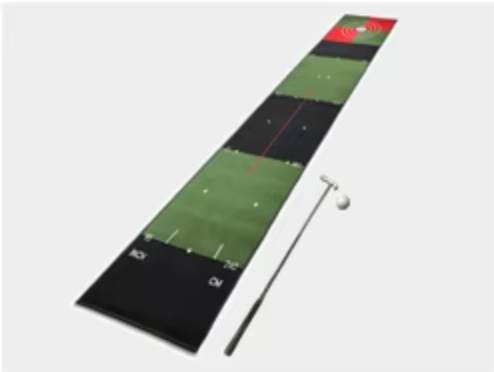
A Real Green Is More Than Green Carpet
A putting green tricks the eye because the ball behaves, not because the surface looks like grass. The best golf putting mats chase that behavior: a true roll, a predictable break, and a feel under the putter that does not lie. A mat that only looks the part fails the moment a player trusts it, which is why the good ones obsess over what the ball does rather than what the eye sees.
Most buyers start with color and pile, then discover the roll is the thing that matters. A surface that sends the ball off line by a fraction trains the wrong stroke. The point of practice at home is to build a repeatable motion, and a mat that lies about break teaches the opposite.
Real putting surfaces share a few traits that a mat has to echo: a fast, true roll on the flat, a readable break on the slope, and a firm base that does not shift under the stroke. Skip any one and the practice stops transferring. The mats worth owning treat all three as a system, not a checklist.
Surface Texture Sets the Roll
The ball's path comes down to how the fibers meet it. A dense, low pile turf gives a cleaner roll than a fluffy one, because there is less fiber to grab and deflect the ball. Nylon and polyester both show up in quality mats, with nylon holding its shape under repeated contact and polyester costing less while still rolling true at short distances.
Pile height is the quiet variable. Too tall and the ball rides up on the fibers, slowing and wandering. Too short and the mat feels dead and unlike any green a player actually faces. The sweet spot tracks the speed a player wants to practice, not a single fixed number.
Three quick checks separate a trainer from a toy:
- Roll a ball by hand and watch for drift, because sideways wander means uneven pile.
- Press the surface with a palm, because a dip under light pressure shows weak backing.
- Read the nap direction, because a reversing grain breaks putts the way real grain does, only unpredictably.
Wear tells the truth over time. A mat that mats down in the center after a few weeks changes the roll exactly where a player practices most, which quietly trains inconsistency. Getting the density right up front is cheaper than discovering the dead spot later.
Speed Needs a Target, Not a Guess
Real greens get measured. Superintendents use a stimpmeter to rate how far a ball rolls, and that number varies by course and season. A mat that claims one universal speed misses the point, because players practice for the greens they play. The better mats aim for a band of speed that mimics a well-kept mid-range green, so the stroke transfers to the course.
The table below shows how build choices push the roll toward or away from realistic.
|
Build factor |
Realistic when |
Unrealistic when |
|
Pile density |
Tight and even |
Loose, uneven |
|
Fiber type |
Nylon or quality polyester |
Cheap, shedding fiber |
|
Backing firmness |
Firm, flat underfoot |
Soft, dips under weight |
|
Surface nap |
Consistent directional nap |
Mixed, reversing nap |
A consistent nap matters more than people expect. Real greens have grain that bends putts, and a mat with a uniform fiber direction lets a player read break the same way every time, which is the whole point of repetition. None of this replicates real grass grain perfectly, since natural grain shifts with light and mowing pattern, but a uniform synthetic nap at least removes the variable that ruins indoor practice.
Contour and Break Separate Toys From Trainers
Flat is easy and flat is limiting. A mat that adds a gentle, even contour teaches the eye to read slope, which is where most putting strokes actually break down. The contour has to be subtle and true, because an exaggerated hump trains a stroke that fights real greens.
During a retrofit at a teaching academy's indoor bay, swapping a flat rug for a denser turf mat with a mild built-in slope brought the putts rolled indoors closer to what students faced on the course. The change shortened the time it took them to adapt when they stepped outside, though the gain built up across sessions rather than appearing in one lesson.
Contour also has limits. A mat cannot fold the way a bent green does, and it cannot reproduce the speed change that comes with uphill versus downhill grain. Treat the slope as a reading exercise, not a course replica.
Firmness Underfoot Closes the Gap
A mat that sinks under the player feels nothing like a green. The backing has to hold firm so the stance and the stroke stay the same as outdoors. Foam-backed designs vary widely here, and the thin, cheap versions dip just enough to change the putter arc. A layered backing that stays flat under weight keeps the motion honest.
This is where construction beats decoration. A mat printed with a pretty green pattern but built on weak foam teaches a stroke that does not travel. The firm, plain-backed option usually wins for anyone serious about transferring practice to the course.
Care keeps the roll honest. Debris in the pile grabs the ball, so a quick brush before a session restores the surface. A mat that rolls up without creasing also keeps the nap aligned, which protects the break you trained.
A Maker That Controls the Run From Fiber to Finish
Practice gear lives or dies on consistency between units. A supplier that runs its own production lines with controlled quality checks keeps pile density and backing firmness steady from the first mat to the thousandth, which is what lets a player trust the surface session after session. Shenzhen Dotcom Houseware Products Co., Ltd. operates in-house production with a monitored process, supplying both retail lines and bulk programs. Custom orders carry a minimum order quantity of 3000 square meters.
The same operation supports home studios, club fitting bays, and teaching academies, so the build standard carries across the places people actually practice. When the goal is a mat that still rolls true a year in, that steady control matters more than a bold claim on the box.