 EN
EN

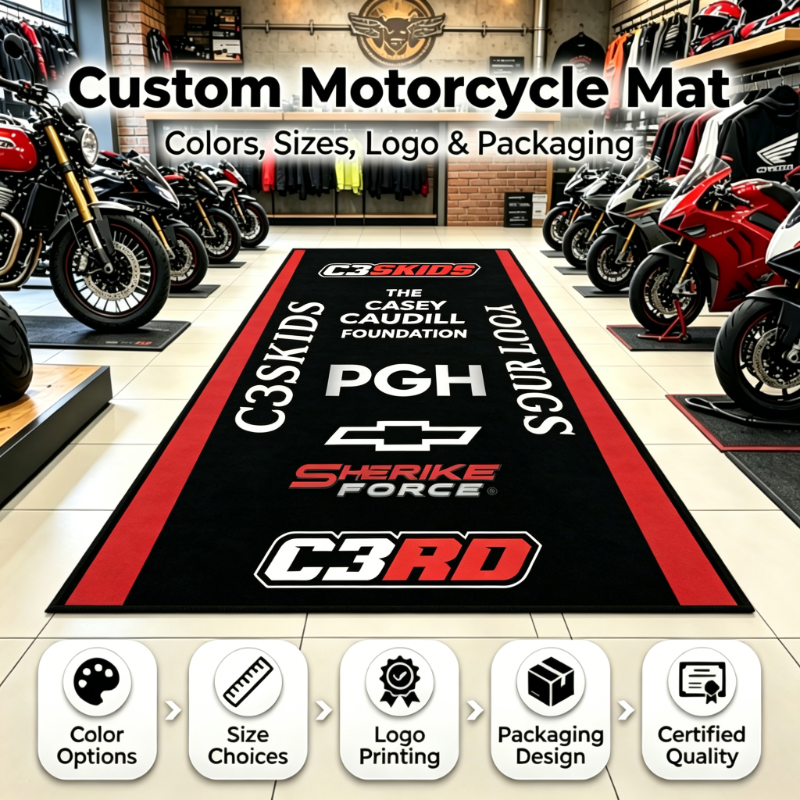
So you have finally cleaned up the garage and want to keep it that way. Or maybe you are tired of mopping up oil spots and mud stains every time you park your bike. A good motorcycle floor mat can be a lifesaver. But here is the thing that trips up a lot of riders: picking the wrong size. You grab any mat off the shelf thinking it will work. Then you park your bike and half the front wheel hangs off the edge. Or the mat is so huge it curls up under your kickstand. Not fun.
I have been there. I learned the hard way that getting the right fit for your specific bike model makes all the difference. And on top of that, the material of the mat matters almost as much as the size. So let me walk you through some real world tips to help you choose a motorcycle floor mat that actually fits your ride and holds up over time. No fancy jargon, just plain talk from one rider to another.
Understanding why size and material both matter for a motorcycle floor mat
You might wonder, does a few inches here or there really matter? Oh yes. Think about what a motorcycle floor mat is supposed to do. It catches drips from your engine, chain lube, and brake fluid. It gives your kickstand a solid, nonslip surface so your bike does not tip over. And it keeps your garage floor free from tire marks and dust. If the mat is too small, those drips land right on the concrete. If it is too big, you trip over the extra edges when you walk around the bike.
But size alone is not enough. The material decides how long the mat lasts, how well it handles oil and gasoline, and whether it stays flat or curls up after a few months. Some mats use nylon pile with a rubber backing. Others use polyester with PVC or TPR. Each has its own strengths. For example, nylon plus rubber handles heavy traffic and sunlight really well. Polyester plus PVC is great for indoor displays because it resists water and oil without soaking anything up. So when you shop for a motorcycle floor mat, you need to think about both the footprint and the build.
Measuring your bike's footprint the easy way
Alright, let us get practical. You do not need any fancy tools. Just a tape measure, some chalk or masking tape, and maybe a helper if your bike is heavy. First, put your bike on its kickstand on a flat surface. If you have a center stand, use that instead because it gives a more stable footprint. Now look at where the tires touch the ground. Mark those spots with a small piece of tape or a chalk dot. Then mark where the kickstand or center stand touches. That is your main contact triangle.
Now measure from the front edge of the front tire contact patch to the back edge of the rear tire contact patch. Add about 4 to 6 inches to both the front and the back. That gives you the ideal length. For width, measure from the outside edge of the left side of the bike (usually the kickstand or a low hanging part) to the outside edge of the right side. But here is a common mistake: do not just measure the tires. Your mat also needs to catch drips that fall from the engine area, which is often wider than the tires. So measure the widest part of your bike that is close to the ground. For many sportbikes, that is the lower fairing. For cruisers, it might be the floorboards or the exhaust pipes.
Write down those numbers. Then add a couple extra inches for wiggle room. So if your bike footprint is 60 inches long and 30 inches wide, look for a motorcycle floor mat that is around 66 to 68 inches long and 34 to 36 inches wide. That extra space means you can roll the bike on and off without the tires catching the edge. It also means if you park a little crooked, you are still protected. One more tip: if you have a drip pan or a battery tender that sits under the bike, measure that too. You want everything inside the mat area.
Matching mat size to cruiser, sportbike, and touring models
Different bike families need different mat dimensions. Let us break it down so you know what to look for.
For cruisers like Harley Davidson Softail or Honda Rebel, these bikes have a long, low stance. The wheelbase is usually between 60 and 68 inches. The kickstand sticks out to the left quite a bit. So you need a motorcycle floor mat that is long, maybe 72 to 80 inches, and fairly wide, at least 30 inches. But here is the catch: cruisers often have floorboards or foot pegs that extend sideways. So measure from the outermost left point (could be the kickstand or the floorboard) to the outermost right point (often the exhaust or the foot brake lever). Many cruiser owners find that a rectangle shaped mat works best.
For sportbikes like Yamaha R6 or Kawasaki Ninja, these are shorter in length, usually 55 to 62 inches wheelbase. But they have wide front fairings that can drip oil or coolant. And they often have rear sets that sit high, so not much drips from there. The main thing is the front tire and the engine area. A sportbike typically fits well on a mat that is 60 to 66 inches long and 28 to 32 inches wide. However, sportbike riders often park their bikes at an angle because the steering is turned. So get a mat that is a bit wider than you think. A narrow mat might leave the front tire half off if you turn the bars.
For touring bikes like BMW R1250RT or Harley Electra Glide, these are heavy and long. Wheelbase can go over 70 inches. They also have large engines that drip more fluids over time. And many touring bikes have side cases that hang low. So your motorcycle floor mat needs to be big, like 80 inches long and 36 to 40 inches wide. Do not skimp on size here. A small mat under a big touring bike is useless. You will end up with oil stains on your nice garage floor anyway. Also, touring bikes are often parked with the handlebars locked, which changes the lean angle. So give yourself extra inches on the left side where the bike leans.
Comparing common material options for your mat
Now let us talk about what the mat is actually made of. The table below gives you a quick look at three popular material combinations you will find in the market. Each works well for different garage situations.
|
Material Type |
Pile & Backing |
Best For |
Key Strength |
|
Nylon plus Rubber |
100% nylon pile with heavy rubber backing |
Outdoor garages, sunny spots, busy workshops |
UV stable, resists gasoline and acetone |
|
Polyester plus PVC |
100% polyester pile with PVC backing |
Indoor display areas, showrooms, home garages |
Waterproof, oil resistant, holds shape under heavy loads |
|
Polyester plus TPR |
100% polyester pile with TPR backing |
Light duty home use, easy cleanup areas |
Flexible, good grip, more eco friendly |
Take the nylon and rubber combo for example. It stands up to sunlight really well, so it will not crack or fade if your garage gets a lot of daylight. It also laughs at harsh fluids like brake fluid or hydraulic oil. That is why many professional workshops go with nylon rubber mats. On the other hand, polyester with PVC is great for showrooms or home garages where you just want something that cleans up fast and looks sharp. TPR is a softer, more environmentally friendly option that still gives you decent grip. Some product lines like the DK 2450 (nylon plus rubber), DK 2400 (polyester plus PVC), and DK 2350PT (polyester plus TPR) let you pick exactly the right material for how you use your garage. So do not just look at size. Look at the material specs too.
Checking thickness, edge design, and custom features alongside size
Size is not the only thing. You can have the perfect length and width, but if the mat is too thin, it will curl up at the edges. Then you trip over it. If it is too thick, the kickstand might not dig in properly and your bike could feel wobbly. A good motorcycle floor mat should have a backing thickness around 2 to 3 millimeters. That is the sweet spot. Thick enough to catch fluids without letting them soak through, but thin enough that the kickstand makes a solid dent and the mat lays flat.
Also look at the edges. Some mats have a rubber edge band that is about 1.5 or 2 centimeters wide. That helps prevent the corners from curling and gives you a nice finished look. Other mats have no edge at all, which is fine if you are putting them under cabinets or in a tight spot. For most home garages, a mat with a rubber edge lasts longer and looks more professional.
Now here is where things get fun. You can get custom sizes and even custom printing on your mat. That means you are not stuck with whatever the store has on the shelf. For example, brands like Dotcom allow you to order a single piece with no minimum quantity. The maximum width is 200 centimeters, and the regular length goes up to 600 centimeters. If you need longer, you can pay a small extra fee. You can also add your own logo, your bike club name, or a cool drag race design. The printing uses fade resistant technology, so your custom artwork stays sharp for years. Just remember that letters should be at least 4 centimeters tall to be readable, and avoid putting similar colors next to each other. This kind of customization turns a plain motorcycle floor mat into something that really shows off your personality.
A few final checks before you buy
You have measured your bike. You have picked a material. You have decided on size and custom options. Now do a few last sanity checks. First, make sure the mat has a nonslip base. You do not want your bike moving around when you lean it on the kickstand. Second, think about cleaning. A mat that you can just hose down or wipe with a damp cloth is way better than one that needs special cleaners. Third, check if the mat is certified for safety and environmental standards. Look for things like ISO 9001, BSCI, or OEKO Tex certification. Those tell you the factory knows what it is doing and the materials are not full of nasty chemicals.
One more thing. If you have multiple bikes, do not try to use one giant mat for all of them unless you have a huge garage. Bikes drip in different spots. A shared mat often means you are parking each bike in a different position, and then you get gaps in protection. It is better to buy separate mats for each bike. That way each motorcycle floor mat is tailored to that model. Plus, it looks cleaner and you can move each mat independently when you clean the garage.
Take care of your garage floor, and it will take care of your bike. A properly sized and well chosen motorcycle floor mat saves you from scrubbing oil stains and slipping on wet concrete. Plus, it just looks professional. So grab that tape measure, check your bike, and order the right size and material the first time. You will thank yourself every time you roll in after a long ride.
Table of Contents
- Understanding why size and material both matter for a motorcycle floor mat
- Measuring your bike's footprint the easy way
- Matching mat size to cruiser, sportbike, and touring models
- Comparing common material options for your mat
- Checking thickness, edge design, and custom features alongside size
- A few final checks before you buy